
Immigrant Strong: January 2026 Issue
On Minneapolis, reimagining the American road trip novel, and birding

Hi there,
Less than a month into 2026, we’re in a hellscape thanks to the racist madman running our country and everyone allowing his crimes. ICE is killing, injuring and detaining citizens and noncitizens, kidnapping children from their homes and neighborhoods, and separating them from their families. My friends in Minneapolis are collecting diapers, baby food and other essentials for immigrant and other families scared to leave their homes. Kids are afraid to go to school, many people have stopped going to work out of fear of getting detained by armed and masked agents, and parents carry their documents when they leave for food or medicine.
The Republican-run Congress, which long ago lost its last shred of morality and human dignity, is trying to avoid accountability for federal officials who murdered two unarmed civilians—Renee Good, a poet and mother of three, and Alex Pretti, an ICU nurse. All this so our far-right leadership can amass power and continue attacking immigrants, communities of color, and the poor and vulnerable (while tanking the economy, accelerating the climate crisis, and enriching billionaires). I’m thinking of Amanda Gorman’s words: “Yet our greatest threat isn’t the outsiders among us, but those among us who never look within. Fear not the those without papers, but those without conscience.”
Even as our government wages war against its own people, the incompetent bullies in charge think they should run other countries, with Venezuela, Greenland, and Cuba among the recent examples of America’s never-ending meddling. Our officials are embracing dictatorship, blocking investigations, and abandoning laws, norms, and principles. For those in shock about what is happening, this is what fascism and authoritarianism look like. This is state-sponsored violence. This is a government using its military machinery to instill fear, squash dissent, and terrorize communities.
I hope you are finding ways to stay safe and sane, to feed your writing and art, and help those in need if you can. And that you are standing in solidarity with Minnesota, Illinois, New York and other places that are being violated while demonstrating to everyone the power of courage and community. If you can donate, please consider sites like Stand With Minnesota. Call or write to your representatives and demand they not give another penny to ICE, a rogue and lawless organization that must be abolished. Join calls like this one tonight, connect with organizations like Indivisible, and find local groups and organizations where you live.
Every little thing you do or say against these horrors is better than ignorance and denial. And it may mean a whole lot to someone who is struggling and feels lonely trying to process the disturbing and dangerous reality of this country. None of this should ever be normalized, and if you are enraged, scared, sad, or horrified, it means you are human and have not been brainwashed by a lying and evil government. Raksha Vasudevan’s recent post reminded me about the importance of documenting, recording, and witnessing—and I deeply related to what she wrote about “ethical loneliness.”


I’m trying to remain mindful of the good in this world and am grateful my year started with a fellowship at the Virginia Center for the Creative Arts. A week was far too short—I was among the first to leave—but as a parent of a young child, I’m very appreciative of any place that offers short-term and flexible residencies.


Book
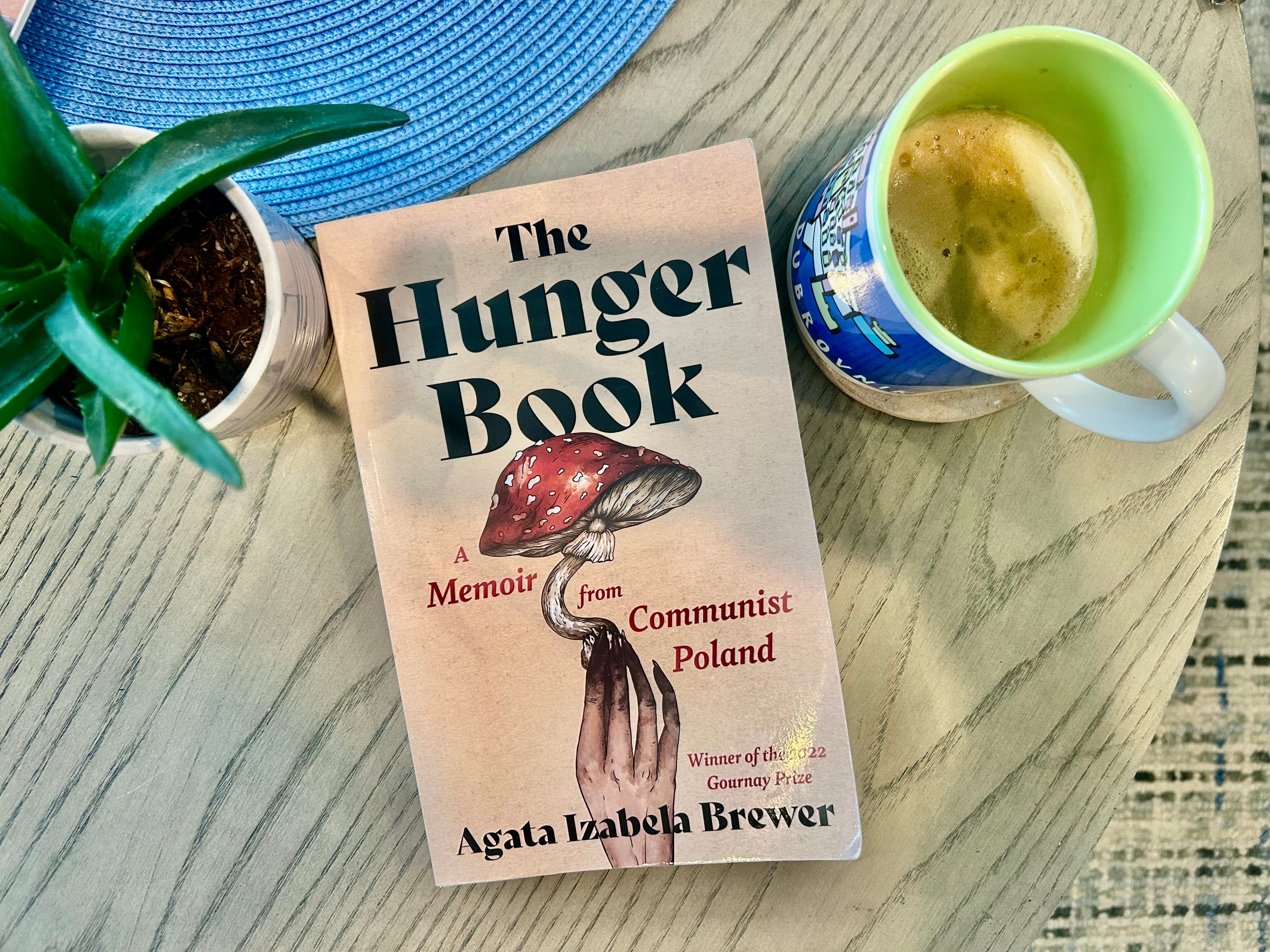
Agata Izabela Brewer’s The Hunger Book: A Memoir from Communist Poland was relatable for me—I’m the same age as the author, grew up not far away in Yugoslavia, and also ended up in the United States. I appreciated how she connected topics like mushrooms and motherhood, and addiction and hunger, as well as her reflections on the meaning of food as a child, an immigrant, and a parent.
Essays and Interviews
I’ll start with this excellent read about how states commit violence through erasure, bureaucracy, and administrative powers. It’s about Gaza and a researcher’s work studying governance systems, and is very fitting given what is also going on in the United States. For The Rumpus, Hazem Almassry wrote What They Don’t Teach You About Collapse.
“What interests me, what keeps me up, is how openly it operates now. There’s no pretense anymore. No fig leaf of legality or claim of proportionality. The state simply decided that certain populations could be treated as problems to be solved through removal or death, and it did that thing, and most of the world watched or looked away or accepted the explanation that this was necessary or defensive or complicated.”
José Orduña penned this powerful Brevity piece, White Female, Brown Male, Black Vehicle.
“He crouches and makes small talk, which I know is his attempt to get me to talk so that he and his partner can use any inconsistency in our answers to manufacture probable cause and search the vehicle. I can see that his eyes have become fixed on the fresh stick and poke on my left forearm, a large black nopal tattooed a month ago in a punk house in Arizona the night I came out of the desert where a group left gallons of water so people would not die breaking into the country that destroyed theirs.”
I enjoyed Shoshana Akabas’s piece on Fátima Vélez’s Galápagos novel for Electric Literature, The Book That Infected Its Translator’s Body.
“Galápagos is very interested in the inequity that’s built into the fabric of language and how language creates limits in what can be expressed. And so, thankfully, because Fátima is interested in that subversion, I felt license to break the rules in the same way she did.”
This was a heart-wrenching piece to read for me. For Granta, Sujatha Gidla wrote I Am My Mother’s Older Brother, which I think will resonate with many of us who live in the diaspora and are part of the sandwich generation.
“I blamed my mother’s new circumstances for the changes I observed in her. And when for the first time a serious strain was put on our relationship, I blamed the social and cultural gap that came from my moving to America. I myself had gone from taking pride in my innocence and over-politeness to being firmer and more street-smart, even assuming a typical New York impatience. Also, having left India in search of a freer life – both as an untouchable in a caste society and as a woman in a patriarchal one – I had adopted the American norms of dating and living with boyfriends, which are not common even in big cities in India.”
For The Rumpus, here is Reimagining the American Road Trip Novel: A Conversation with Winnie M. Li.
“When I was going to Route 66 museums, I saw there was only a certain kind of person driving Route 66. We see that in classic road trip narratives in which predominantly white men get to crisscross the country seeking glory and adventure. They get to know the people without feeling threatened physically, or like they’re out of place. I wanted to write something that challenges that from the perspective of people of color.”
Farah Naz Rishi penned this gorgeous essay for LitHub, Feather By Feather: On Life, Death, and Birding.
“At night, I would cry until my throat hurt, telling Stephen, the man who would become my husband, that I felt like I no longer belonged anywhere. My brother was gone. The year before, my dad had died; later, my mother, taken by illness. Home had become a memory instead of a place.
I was molting. Shedding pieces of myself that once felt permanent. Grief had stripped me down to something raw and featherless. I didn’t recognize what remained.”
I’ll end with this thoughtful and beautifully written epiphany essay by Asya Graf, Shovel People.
“I keep poring over these letters from a country that should have taught us a lesson but didn’t—and when I say “us,” I mean us Russians, us Americans, us Westerners who would like to believe, despite all evidence to the contrary, that the underpinnings of our political systems are still largely democratic. I keep scrutinizing the actions of my grandparents, as though I could learn something from their adaptation to shovelhood.”
Thanks for reading,
Vesna
About this newsletter: Writing about immigrant and refugee life—the struggles, triumphs, and quirks—by immigrants and refugees, children of immigrants and refugees, and others living between countries and cultures. For more info, here is a Q&A I did with Longreads about the newsletter. Photo in the logo: Miguel Bruna/Unsplash.
About me: I grew up in the former Yugoslavia, then immigrated to Canada, and now live in the United States, where I work as a writer for nonprofits in the human rights and international affairs fields. I have written for three anthologies (Back Where I Came From: On Culture, Identity, and Home; Connecticut Literary Anthology 2024; and Connecticut Literary Anthology 2023) as well as Electric Literature, The Los Angeles Review of Books, The New York Times, Pigeon Pages, the Washington Post, the New York Daily News, and Catapult, among others. I was a fellow at the Virginia Center for Creative Arts (‘26), Writer in Residence at Hedgebrook (‘25), participated in Tin House (‘24 and ‘21) and Kenyon Review (‘24) workshops, and won the Poet & Author (‘24) and Parent Writer (‘20) fellowships from Martha’s Vineyard Institute of Creative Writing. Find me on Instagram and Bluesky.
Thank you Vesna for including my essay and links to everyone's pieces, and for what you say about the dangers of normalization!
Vesna, tysm for taking this space to talk about Minnesota and for linking to my newsletter. Love reading your newsletter as always.