
Immigrant Strong: May 2026 Issue
We are 7 years old! Essays on language alienation, leaving Vietnam, and being othered into belonging

Immigrant Strong is now 7 years old! Woo-hoo! Over 92 posts, I have featured about 100 books and hundreds of essays and interviews with writers who have immigrant and refugee roots. While most of them are memoirs, I’ve also recommended novels, short story collections, poetry books, and a couple of children’s books-- the vast majority overall written by women of color.
Thank you to the more than 1,300 of you who subscribe—I have found community among you and appreciate every click on the heart button, social media share, and recommendation. These actions give the newsletter an algorithm boost so it can reach more readers. And the more we can uplift these writers and grow the immigrant literature canon in this chaotic world, the better. Thanks to you, Immigrant Strong has always been free, I have not spent a penny on marketing, and I plan to keep it going for free.
The readership spans 44 states and 63 countries (appropriate given that I have been to more countries than states). As expected, the United States is in the lead, but I was surprised to see the readers’ next three countries of residence were Canada, the United Kingdom, and Italy. We even have 31 readers in Australia! If you want to connect beyond the newsletter, find me on Instagram.
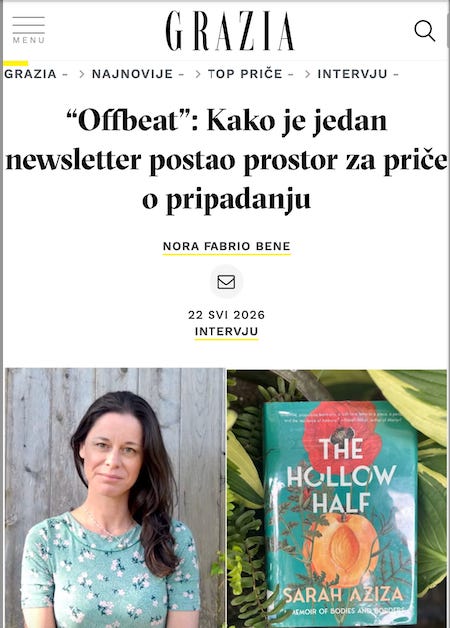
I’m excited to share I was interviewed by Grazia Croatia (the magazine article is in Croatian). It was a truly thoughtful interview by Nora Fabrio Bene about why I started the newsletter and the importance of sharing immigrants’ stories; the abysmal state of human rights in the United States; and the reality that human rights protections historically ebb and flow. I got to mention several memoirs I’ve featured here, including Sarah Aziza’s The Hollow Half, Hala Alyan’s I’ll Tell You When I’m Home and Viet Thanh Nguyen’s A Man of Two Faces. And since May is Eurovision month, check out my Electric Literature piece in case you missed it last year, Eurovision Reminds Me of a Country that No Longer Exists.
Book
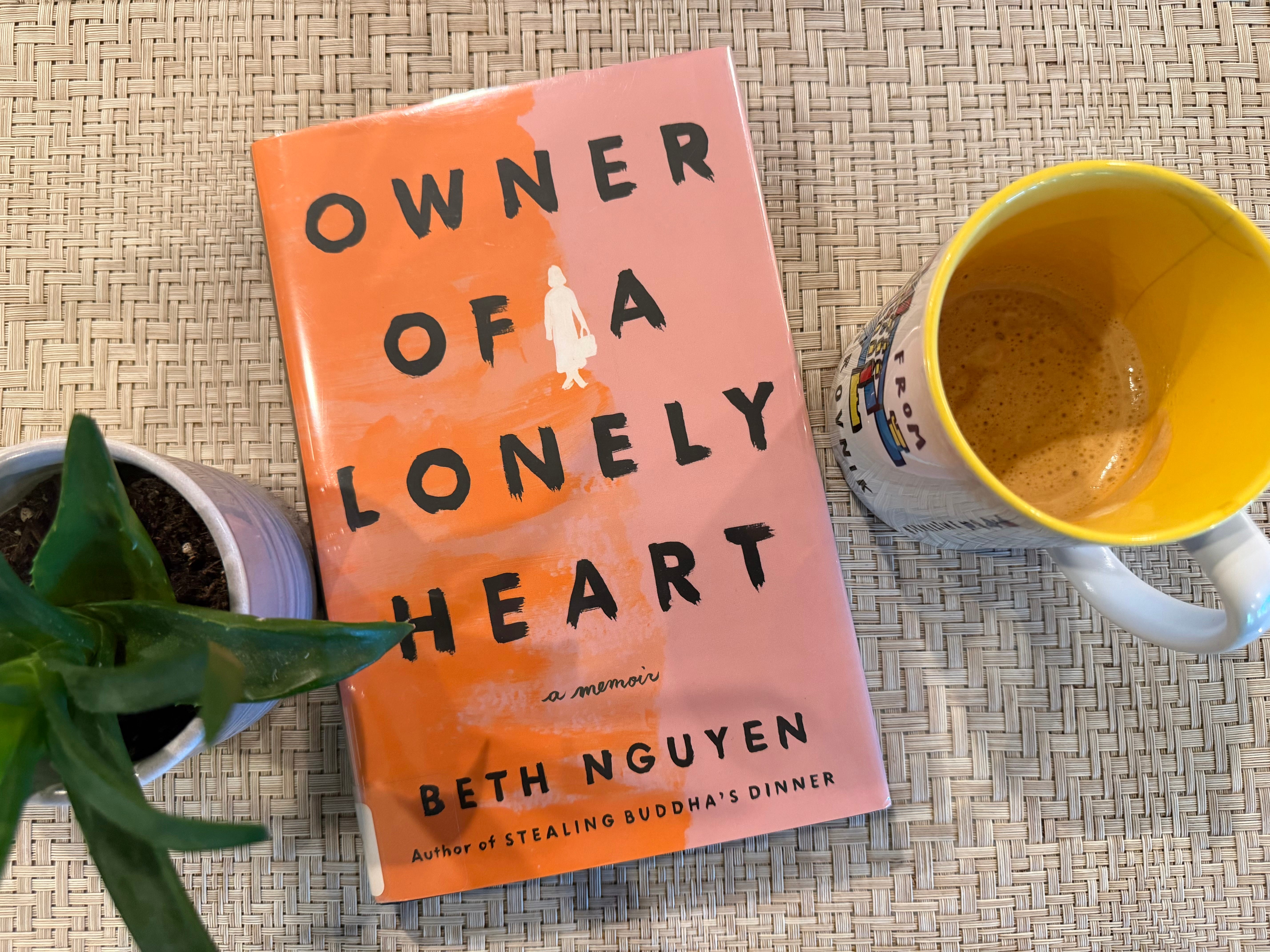
Beth Nguyen’s Owner of a Lonely Heart explores her refugee family’s journey from Vietnam and her relationship with her birth mother, with whom she has spent less than 24 hours. It’s a quiet and searching memoir, and I appreciated her reflections on everything from loneliness and parenthood to finding herself in books.
Essays and Interviews
I’ll start with Yasmin Roshanian’s stunning essay exploring topics I and probably many of you obsess about, such as existing in the in-between, losing a language, and trying to connect to our home and culture. For off assignment, here is Darde Ghorbat.
“Darde ghorbat—my alienation wasn’t and isn’t from Iran itself. It’s in how Iran seeped into every inch of my life, eroding everything that felt normal. It’s the place that’s always been locked in someone else’s memory; an impression relayed through photographs. It’s also a mirror I can’t ignore. I don’t know which loss is worse—to be marked with a place or to only exist in the periphery of it, scaling its receding edges. My parents' loss is tangible. Mine is only an echo, but it doesn’t stop reverberating.”
For LitHub, Chenxin Jiang wrote Mother Tongues: How Family History Plays a Part in Language and Translation.
“The notion of a mother tongue assumes that language functions as a common thread in families, tying parent to child. My experience of being an immigrant twice over—first from my family’s move to Hong Kong and then from my move to the US for college—is that the common thread between my parents’ version of parenting as an immigrant and my own version of it is the privileging of the expedient over the thing that merely feels right.”
Here is another gorgeous essay on the topic of language by poupeh missaghi—Alienated from My Languages for the Los Angeles Review of Books.
“The world that we have known is crumbling, and we do not yet have language capable of capturing and containing the horrifying truths of AI-driven wars and malicious governments. This is our moment of collapse, both of language and in language. What can we do now but mourn our losses? Hoping we can find our way back into a world where the capacity of language is restored—where it can bring life and liberation.”
Also in the Los Angeles Review of Books, Long T. Bui interviewed Andrew Lam about leaving and returning to Vietnam and a lot more in Cooking Up a Quiet Storm.
“When I started telling my refugee story all those years ago, I never thought that simply telling my story could be seen as an act of resistance. But clearly it has become that to many who currently hold political power. If Anne Frank’s diary teaches us anything, it’s that the stories of the oppressed and the invisible must, by all means, be told, must—be it through literature, movies, or songs—find their way into the light.”
For Electric Literature, Bareerah Ghani spoke with Hasan Dudar about being Othered Into Belonging as a Palestinian American in Toledo, Ohio.
“I don’t want to generalize. There are so many different facets of the Palestinian identity. But I think one of the key parts is this sense of exile and displacement. You’re denied the acknowledgement of what’s taken place. And whether you’re born in Gaza, or West Bank, or Akka, where my father’s family came from, that sense sticks with you.”
Rebecca Bihn-Wallace wrote about M Lin’s debut collection The Memory Museum in Reckoning With the Desires of China’s One-Child Generation for Electric Literature.
“But right now, especially in China, there is one part of you that is based on what other people think you should do—your family, your parents, the culture—and the other part is that people in China are retreating from this, almost retreating from capitalism. I think the women [in my stories] are not choosing the path that was expected of them, and they aren’t choosing to give in and completely lose control of their lives. Despite the hostile environment around them, they’re still trying to fulfill themselves in some way. And that is not an easy thing to do in the age of declining mental health and world chaos.”
I think many immigrants can relate to the sentiments expressed in this piece on returning to one’s home country. Here is May Teng’s On Homecoming (and Leaving), Jakarta to New York in LitHub.
“I orbit the round tables and kiss my various uncles and aunts on the cheek, alternating between kiong hee huat chai and gong xi fa cai to demonstrate my command of Hokkien and Mandarin. Oldest Uncle, Second Oldest Uncle, Second Youngest Uncle’s Second Wife, Older Aunt’s Husband, hi, how are you, apa kabar, kiong hee, yes, it’s been so long! Yes, of course I speak Chinese, just like your sons and daughters. Of course I still remember my Bahasa. How could you claim me if I didn’t.”
I’ll wrap it up with this interview in The Rumpus, Who Deserves Your Compassion? A Conversation with Megha Majumdar.
“One of the fascinating things about migration is that it can be an event of pride and satisfaction and joy. It’s such an accomplishment to build a new life in a new place. At the same time, it can also be an event of such sorrow. You leave behind your family. You leave behind your mother tongue. You leave behind everything that has so far been obvious about the world—food, manners, what’s okay and what’s not okay.”
Thanks for reading Immigrant Strong!
vesna
About this newsletter: Writing about immigrant and refugee life—the struggles, triumphs, and quirks—by those with immigrant and refugee roots, and others living between countries and cultures. For more info, here is a Q&A I did with Longreads about the newsletter. Photo in the logo: Miguel Bruna/Unsplash.
About me: I grew up in the former Yugoslavia, then immigrated to Canada, and now live in the United States, where I work as a writer for nonprofits in the human rights and international affairs fields. I have written for three anthologies (Back Where I Came From: On Culture, Identity, and Home; Connecticut Literary Anthology 2024; and Connecticut Literary Anthology 2023) as well as Electric Literature, The Los Angeles Review of Books, The New York Times, Pigeon Pages, the Washington Post, the New York Daily News, and Catapult, among others. I was a fellow at the Virginia Center for Creative Arts (‘26), Writer in Residence at Hedgebrook (‘25), participated in Tin House (‘24 and ‘21) and Kenyon Review (‘24) workshops, and won the Poet & Author (‘24) and Parent Writer (‘20) fellowships from Martha’s Vineyard Institute of Creative Writing. Find me on Instagram and Bluesky.
Thank you so much for highlighting Darde Ghorbat! 🥹
Welcome thoughts and observations Vesna! Your topic affects many people(s) and
I have experienced it myself, but without hardship as a motivation Back in my native
Toronto now! Thanks for keeping it free-it's a bold move that opens up the value of
books and reading to many more people!